Please support the Ministry’s public relations work: We need your consent to be able to measure your user activity on our website using etracker. A pseudonymised evaluation of this data by etracker helps us to improve our website. You can revoke your consent at any time for the future. Once you have made your selection, the consent management screen will appear at the bottom of the page. You can use this to stop or to reactivate the statistical evaluation at any point. You can reactivate tracking by dragging the slider in the opposite direction.
This website sets temporary session cookies. These are strictly necessary and therefore cannot be deselected. Their sole purpose is to enable you to use the website.
The Ministry also presents its work on this website in the form of videos. These are made available by the provider TV1 using JW Player. Please consent to the transmission of your IP address and other technical data to JW Player and allow JW Player to set cookies on your end device if you wish to view videos on our website. We also provide a consent management function for this at the bottom of the page. You can use this to control whether JW Player is enabled or not.
You can find detailed information on your rights and how we protect your privacy in our privacy policy.
Consent to the use of JW Player for video streaming
The Ministry also presents its work on this website in the form of videos. These are made available by the provider TV1 using JW Player. Please consent to the transmission of your IP address and other technical data to JW Player and allow JW Player to set cookies on your end device if you wish to view videos on our website. We also provide a consent management function for this at the bottom of the page. You can use this to control whether JW Player is enabled or not.
Everyone needs electricity and heat – but how to best organise transmission, distribution and storage? Go ahead and learn about the most intelligent designs and solutions!
Energy efficiency is key, both for the current building stock and for everything to be built from now on. Find out more about how the building stock can be made fit for future energy savings!
In tomorrow’s energy world, industries, commerce and agriculture use only a fraction of the energy they use today – with no negative effects on output.
Electromobility and new, alternative fuels are about to fundamentally change the transport sector. Find out more about the characteristics and prospects of these technologies!
In order to achieve an integrated energy system, power, heat and mobility need to be combined in a way that is both intelligent and sustainable. Take a look at relevant approaches in this field!
Are you looking for face-to-face meetings with German companies? Would you like to receive first-hand information? The German energy solutions initiative offers you a number of different possibilities to do so.
Sign up to our newsletter service to receive the latest information about German energy solutions and about opportunities to meet German business partners around the world.
All events
If you are interested in attending an event of the German energy solutions initiative, you will find the dates and locations in our calendar.
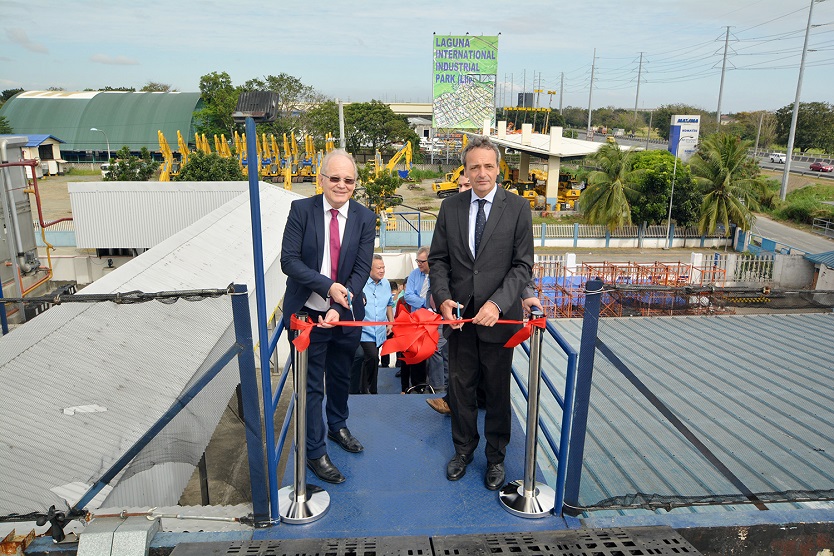
Michael Kurt Räuber (left), managing director of Royal Cargo Inc., and Ambassador Dr. Gordon Kricke officially inaugurate the 225-kWp solar rooftop expansion
In 2015, the German project developer Aschoff Solar GmbH implemented a 245 kWp PV rooftop plant on a cold storage facility of the industrial company Royal Cargo in Binan City, Laguna near Metro Manila with the support of the Project Development Programme (PDP) of the Export Initiative Energy.
The rooftop PV system was designed as a captive power plant only, as there are no plans yet to export the generated electricity to the public grid. Royal Cargo's connection to the grid is for the sole purpose of meeting its internal load requirements. The system was designed as a modular structure based on nine standard string inverters. The standard polycrystalline modules were mounted on the southeast and northwest facing roof surfaces. Power control and metering devices allow the solar power to be reduced in cases where demand is low and therefore there is a risk of feeding into the grid. In addition, there is the possibility of immediate shutdown in the event of a sudden drop in demand without a corresponding drop in available solar power. A high-quality mounting system was used.
The photovoltaic system enabled Royal Cargo, a logistics company, to make significant savings on electricity bills and led to a renewed contract with Aschoff Solar in 2016 for a follow-up phase (another 225 kWp). PDP also accompanied the second phase of the reference project in a scaling approach and provided support for the design of the monitoring and the opening of the new solar plant in February 2017.
Support of the German Energy Solutions Initiative
PDP’s thorough awareness raising campaigns for the potential of solar energy solutions including various studies and reference guides for PV-projects contributed significantly to Royal Cargo’s decision to invest in their own roof-top system.
As a clear-cut and documented licensing procedure for roof-top systems exceeding 100 kWp had not yet been in place, the PDP team facilitated the contact establishment between key stakeholders to set-off such a procedure: the local utility Manila Electric Company (Meralco), the regulatory agency Energy Regulatory Commission (ERC) and various international experts. Throughout a series of workshops, they provided technical expert input.


![Logo [EN]German Energy Solutions](/SiteGlobals/GES/StyleBundles/Bilder/sublogo_en.svg?__blob=normal&v=1 "To homepage")