Please support the Ministry’s public relations work: We need your consent to be able to measure your user activity on our website using etracker. A pseudonymised evaluation of this data by etracker helps us to improve our website. You can revoke your consent at any time for the future. Once you have made your selection, the consent management screen will appear at the bottom of the page. You can use this to stop or to reactivate the statistical evaluation at any point. You can reactivate tracking by dragging the slider in the opposite direction.
This website sets temporary session cookies. These are strictly necessary and therefore cannot be deselected. Their sole purpose is to enable you to use the website.
The Ministry also presents its work on this website in the form of videos. These are made available by the provider TV1 using JW Player. Please consent to the transmission of your IP address and other technical data to JW Player and allow JW Player to set cookies on your end device if you wish to view videos on our website. We also provide a consent management function for this at the bottom of the page. You can use this to control whether JW Player is enabled or not.
You can find detailed information on your rights and how we protect your privacy in our privacy policy.
Consent to the use of JW Player for video streaming
The Ministry also presents its work on this website in the form of videos. These are made available by the provider TV1 using JW Player. Please consent to the transmission of your IP address and other technical data to JW Player and allow JW Player to set cookies on your end device if you wish to view videos on our website. We also provide a consent management function for this at the bottom of the page. You can use this to control whether JW Player is enabled or not.
Everyone needs electricity and heat – but how to best organise transmission, distribution and storage? Go ahead and learn about the most intelligent designs and solutions!
Energy efficiency is key, both for the current building stock and for everything to be built from now on. Find out more about how the building stock can be made fit for future energy savings!
In tomorrow’s energy world, industries, commerce and agriculture use only a fraction of the energy they use today – with no negative effects on output.
Electromobility and new, alternative fuels are about to fundamentally change the transport sector. Find out more about the characteristics and prospects of these technologies!
In order to achieve an integrated energy system, power, heat and mobility need to be combined in a way that is both intelligent and sustainable. Take a look at relevant approaches in this field!
Are you looking for face-to-face meetings with German companies? Would you like to receive first-hand information? The German energy solutions initiative offers you a number of different possibilities to do so.
Sign up to our newsletter service to receive the latest information about German energy solutions and about opportunities to meet German business partners around the world.
All events
If you are interested in attending an event of the German energy solutions initiative, you will find the dates and locations in our calendar.
150 kWp PV system for Simbi Roses flower farm
In cooperation with the German company ecoligo a 150 kWp solar system was installed at the Simbi Roses farm in Kenya.
In Kenya's commercial and industrial sector, most companies are still supplied with energy from the national grid. However, given the favorable climatic conditions in the region, solar energy offers an attractive alternative for these companies.
A 150 kWp solar power system has been installed at the Simbi Roses farm. The system provides the flower farm with clean energy during the day, saving up to 144 tonnes of CO2 emissions per year. Self-consumption solar systems are well suited to cover the daytime energy needs of flower farms. As the flower industry relies on the natural environment, forward thinking companies such as Simbi Roses are needed to set the trend towards sustainable energy use, which is a vital pillar of environmental protection.
The ground-mounted solar PV system, that has been installed at Simbi Roses farm in Thika, Kenya, consists of rows of solar panels converting energy from the sun into electricity, inverters changing this electricity from a DC current to AC current, and a monitoring system tracking the output of the system. The power produced is supplied to the farm’s electrical system.
The farm is still connected to the national grid. However the energy produced by the solar systems is solely for self-consumption and is not fed back into the grid. During the night or on cloudy days, when not enough energy is produced by solar power, electricity comes from the national grid. By switching between grid-provided and solar power, Simbi can lower its electricity costs and carbon footprint with solar energy.
Impressions and statements of the project partners
Consent to the use of JW Player for video streaming
The Ministry also presents its work on this website in the form of videos. These are made available by the provider TV1 using JW Player. Please consent to the transmission of your IP address and other technical data to JW Player and allow JW Player to set cookies on your end device if you wish to view videos on our website. We also provide a consent management function for this at the bottom of the page. You can use this to control whether JW Player is enabled or not.
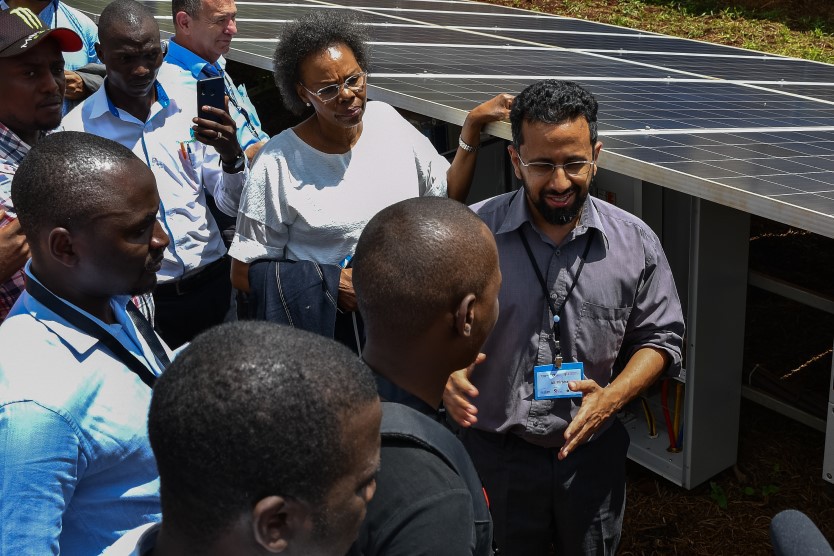
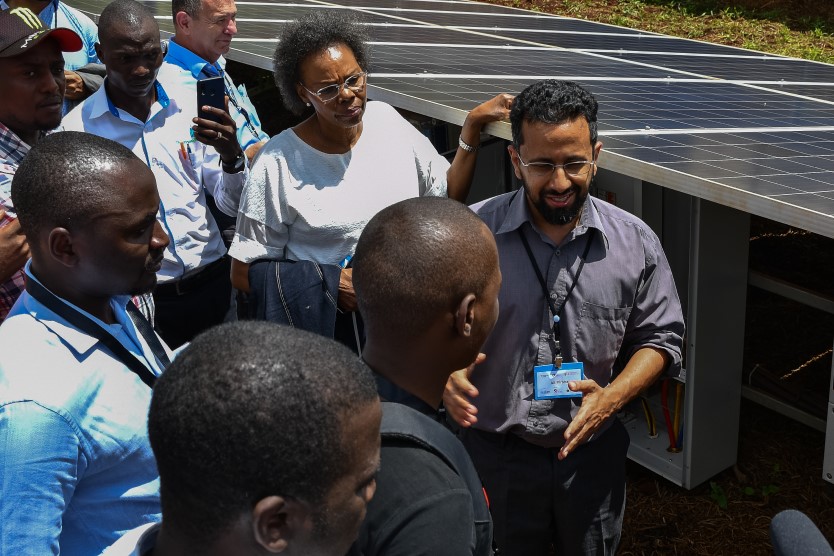
Impressions of the solar-as-a-service flagship project on Simbi Roses flower farm in Kenya
German Contribution
The German company ecoligo operates a leasing model, in which the customer only pays a fixed monthly fee for the use of the solar system. They receive hassle-free electricity and do not need to employ or train staff to manage the system. This project was constructed and is maintained by the local EPC company Technolectric. Through the leasing agreement, Simbi Roses can focus on its core business, while enjoying the benefits of a solar PV system.
The project was coordinated and implemented by ecoligo, which is also the project owner and operator, in cooperation with its partners. As the engineering and turnkey construction company, Technolectric was responsible for the installation and takes care of the ongoing operation and maintenance of the systems.
Rasmus Hansen, Regional Director, Kenya at ecoligo GmbH, at the inauguration ceremony
The Project Development Programme (PDP) of the German Energy Solutions Initiative contributed to awareness for solar and existing business models for financing solar PV in the flower farms sector through flower farm sector-studies, cooperation with Kenya Flower Council and flower workshops that included a site visit to Simbi Roses. The sector has among the highest interest for solar installations in Kenya at present.
In addition, the PDP played a role in matching suitable partners for the project. The early stage project development carried out at Simbi Roses through assessment of energy needs including load measurements gave an initial indication that a solar PV energy generation profile perfectly suits the energy consumption at Simbi Roses. These activities laid the groundwork for successful project implementation.
The project was financed on the crowdinvesting platform www.ecoligo.investments. Private investors can contribute to renewable energy projects from 100 EUR and earn fixed interest rates while lowering CO2 emissions and supporting businesses around the world.


![Logo [EN]German Energy Solutions](/SiteGlobals/GES/StyleBundles/Bilder/sublogo_en.svg?__blob=normal&v=1 "To homepage")