Please support the Ministry’s public relations work: We need your consent to be able to measure your user activity on our website using etracker. A pseudonymised evaluation of this data by etracker helps us to improve our website. You can revoke your consent at any time for the future. Once you have made your selection, the consent management screen will appear at the bottom of the page. You can use this to stop or to reactivate the statistical evaluation at any point. You can reactivate tracking by dragging the slider in the opposite direction.
This website sets temporary session cookies. These are strictly necessary and therefore cannot be deselected. Their sole purpose is to enable you to use the website.
The Ministry also presents its work on this website in the form of videos. These are made available by the provider TV1 using JW Player. Please consent to the transmission of your IP address and other technical data to JW Player and allow JW Player to set cookies on your end device if you wish to view videos on our website. We also provide a consent management function for this at the bottom of the page. You can use this to control whether JW Player is enabled or not.
You can find detailed information on your rights and how we protect your privacy in our privacy policy.
Consent to the use of JW Player for video streaming
The Ministry also presents its work on this website in the form of videos. These are made available by the provider TV1 using JW Player. Please consent to the transmission of your IP address and other technical data to JW Player and allow JW Player to set cookies on your end device if you wish to view videos on our website. We also provide a consent management function for this at the bottom of the page. You can use this to control whether JW Player is enabled or not.
Everyone needs electricity and heat – but how to best organise transmission, distribution and storage? Go ahead and learn about the most intelligent designs and solutions!
Energy efficiency is key, both for the current building stock and for everything to be built from now on. Find out more about how the building stock can be made fit for future energy savings!
In tomorrow’s energy world, industries, commerce and agriculture use only a fraction of the energy they use today – with no negative effects on output.
Electromobility and new, alternative fuels are about to fundamentally change the transport sector. Find out more about the characteristics and prospects of these technologies!
In order to achieve an integrated energy system, power, heat and mobility need to be combined in a way that is both intelligent and sustainable. Take a look at relevant approaches in this field!
Are you looking for face-to-face meetings with German companies? Would you like to receive first-hand information? The German energy solutions initiative offers you a number of different possibilities to do so.
Sign up to our newsletter service to receive the latest information about German energy solutions and about opportunities to meet German business partners around the world.
All events
If you are interested in attending an event of the German energy solutions initiative, you will find the dates and locations in our calendar.
The Philippines are severely affected by the negative impacts of climate change, so they are particularly interested in playing their part when it comes to the global energy transition. The Government plans to gradually increase renewable power production to 15 GW by 2030. According to this expansion plan, photovoltaics will be mainly used for energy self-supply, which will supply the remote archipelago with electricity.
A reference project reduces costs and protects the environment
Palawan Province is not connected to the national electricity grid and currently still depends on diesel, which has to be delivered by ship on a daily basis. Nevertheless, the tourist island has set itself an ambitious objective: it wants to meet its entire electricity demand from renewable energy sources. This is because environmentally friendly technologies are particularly important in Palawan to protect its largely unspoilt nature, to maintain tourism as its primary source of income and to make it even more attractive.
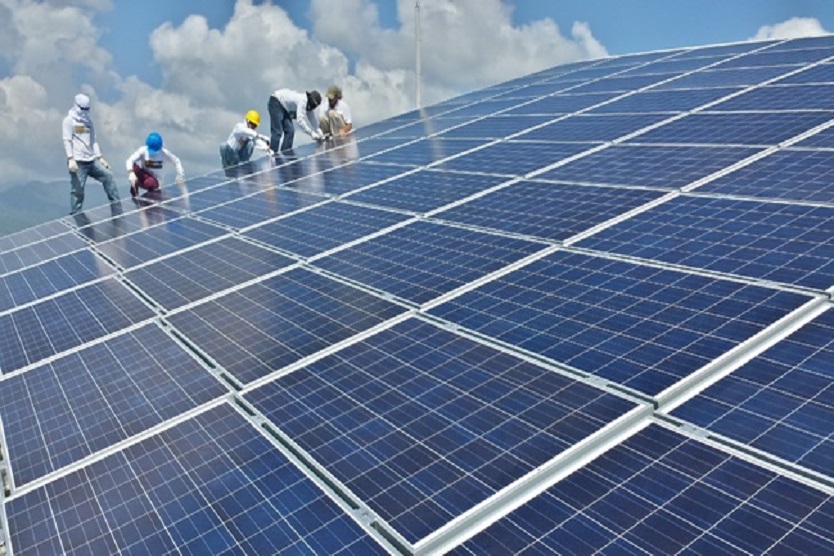
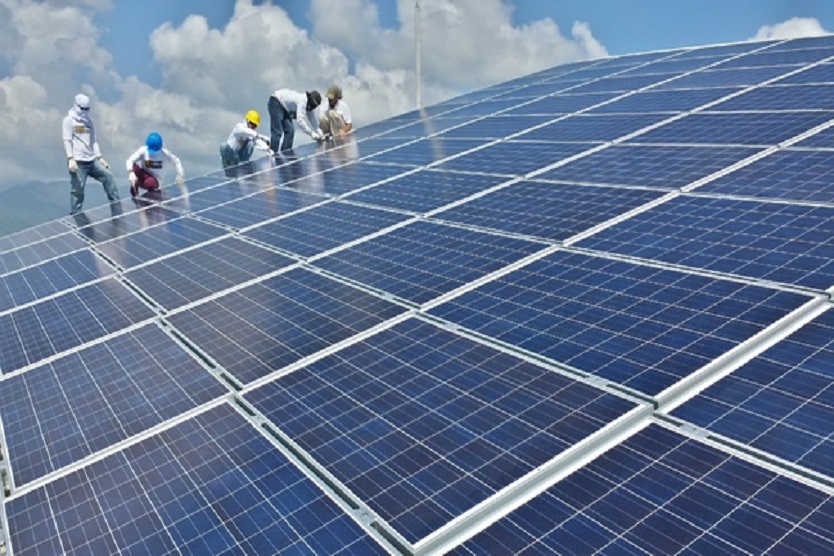
The German consortium made up of Vis Solis GmbH and Solmotion GmbH seized this opportunity on the Philippine market and set up a reference project as part of the Renewable Energy Solutions Programme of the Deutsche EnergieAgentur (dena) – the German Energy Agency. The companies constructed a 78 kWp PV system on the roof of the new City Hall in the capital, Puerto Princesa. This will reduce energy costs by about 20 per cent, while also reducing CO2 emissions by 71,400 kilograms per year. The inauguration of the system on 24th April 2015 attracted considerable public interest. Among those present were José Alvarez, Governor of Palawan Province, Thomas Ossowski, German Ambassador to the Philippines, and other high-ranking representatives from industry, politics and the media.
Since 2011 vis solis GmbH, Breesen, has been a joint venture of Solmotion GmbH, Felde, CASAMA GmbH, Koblenz and ARCANO Beteiligungs-GmbH, Breesen. It was established in April 2009 to plan, build and operate photovoltaic systems. In August 2010, the first international subsidiary company of vis solis was established in the USA, in Franklin, Tennessee. The first free-standing system was constructed in 2011. In late 2012/early 2013, in a private-public partnership, an innovative PV project was installed in the framework of the dena Solar Roofs Programme at a former high-security nuclear bomb research site in Oak Ridge Tennessee. Towards the end of 2013, vis solis expanded to the Philippines to participate in the growth of this region.
System Data:
Installed capacity:
75 kWp
Module type:
300 x Astronergy ASM6610-P 260 W Poly (manufactured in Frankfurt/Oder)


![Logo [EN]German Energy Solutions](/SiteGlobals/GES/StyleBundles/Bilder/sublogo_en.svg?__blob=normal&v=1 "To homepage")