Please support the Ministry’s public relations work: We need your consent to be able to measure your user activity on our website using etracker. A pseudonymised evaluation of this data by etracker helps us to improve our website. You can revoke your consent at any time for the future. Once you have made your selection, the consent management screen will appear at the bottom of the page. You can use this to stop or to reactivate the statistical evaluation at any point. You can reactivate tracking by dragging the slider in the opposite direction.
This website sets temporary session cookies. These are strictly necessary and therefore cannot be deselected. Their sole purpose is to enable you to use the website.
The Ministry also presents its work on this website in the form of videos. These are made available by the provider TV1 using JW Player. Please consent to the transmission of your IP address and other technical data to JW Player and allow JW Player to set cookies on your end device if you wish to view videos on our website. We also provide a consent management function for this at the bottom of the page. You can use this to control whether JW Player is enabled or not.
You can find detailed information on your rights and how we protect your privacy in our privacy policy.
Consent to the use of JW Player for video streaming
The Ministry also presents its work on this website in the form of videos. These are made available by the provider TV1 using JW Player. Please consent to the transmission of your IP address and other technical data to JW Player and allow JW Player to set cookies on your end device if you wish to view videos on our website. We also provide a consent management function for this at the bottom of the page. You can use this to control whether JW Player is enabled or not.
Everyone needs electricity and heat – but how to best organise transmission, distribution and storage? Go ahead and learn about the most intelligent designs and solutions!
Energy efficiency is key, both for the current building stock and for everything to be built from now on. Find out more about how the building stock can be made fit for future energy savings!
In tomorrow’s energy world, industries, commerce and agriculture use only a fraction of the energy they use today – with no negative effects on output.
Electromobility and new, alternative fuels are about to fundamentally change the transport sector. Find out more about the characteristics and prospects of these technologies!
In order to achieve an integrated energy system, power, heat and mobility need to be combined in a way that is both intelligent and sustainable. Take a look at relevant approaches in this field!
Are you looking for face-to-face meetings with German companies? Would you like to receive first-hand information? The German energy solutions initiative offers you a number of different possibilities to do so.
Sign up to our newsletter service to receive the latest information about German energy solutions and about opportunities to meet German business partners around the world.
All events
If you are interested in attending an event of the German energy solutions initiative, you will find the dates and locations in our calendar.
Biogas desulfurization with pellets from Germany proves successful in the Californian market
Renewable Energy Solutions Programme
Introduction
German company UGN-Umwelttechnik GmbH offers an energy-efficient alternative for biogas desulfurization using a filter material made from recycled resources – and demonstrates its performance under real operating conditions in California.
UGN-Umwelttechnik GmbH, is introducing its UgnCleanPellets® to the US market with support from the Renewable Energy Solutions Programme of the German Energy Solutions Initiative. The company provides direct proof of the performance of its product in a state-of-the-art biogas plant in California.
Biogas in California: a growing market with regulatory momentum
California is considered a pioneer of the energy transition in the United States. In 2024, more than 52 percent of electricity generation came from renewable sources, including large-scale hydropower. In this context, biogas and biomethane are gaining strategic importance as dispatchable and storable complements to wind and solar energy.
The potential is significant: organic waste streams such as food waste, manure, and landfill gas are still largely underutilized resources. Their energetic use could significantly contribute to the decarbonization of California’s gas supply. At the same time, biogas supports circular economy approaches, as the remaining digestate can be returned to agriculture as nutrient-rich fertilizer.
Rethinking biogas upgrading
Raw biogas contains hydrogen sulfide (H₂S), a toxic and corrosive gas that poses operational challenges. It damages equipment, increases maintenance requirements, and affects operational safety. Conventional removal using activated carbon is effective but energy-intensive, CO₂-intensive, and limited in capacity.
UGN-Umwelttechnik GmbH addresses this challenge with UgnCleanPellets®, a sustainable, cellulose-based filter material made from recycled resources. The pellets convert hydrogen sulfide into elemental sulfur and offer several advantages: near CO₂-neutral production, no need for gas drying—resulting in energy savings of 40 to 60 percent—and a higher loading capacity compared to activated carbon.
Practical proof in San Luis Obispo
The performance of UgnCleanPellets® is demonstrated in a project on the US West Coast: the Kompogas® plant SLO in San Luis Obispo, California, operated by Kanadevia Inova, a Swiss cleantech company headquartered in Zurich that specializes in converting waste into sustainable energy.
In cooperation with its distribution partner Green Gas Services LLC, UGN supplied eleven tonnes of UgnCleanPellets®, corresponding to a minimum operating period of 24 months. The plant processes 36,500 US tons of municipal organic waste per year and generates more than 6.3 GWh of electricity annually—enough to supply around 600 households.
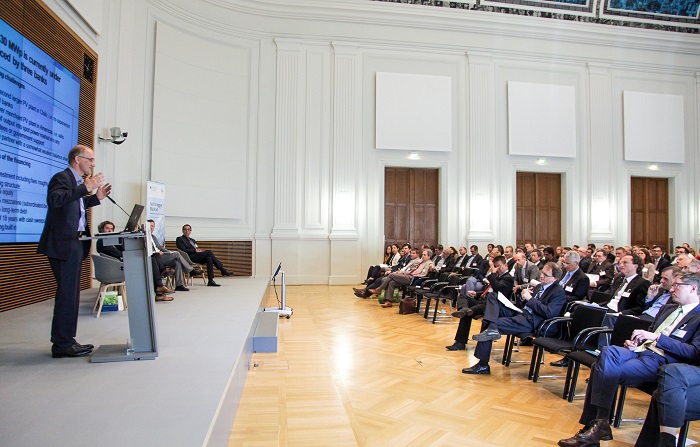
With support from the Renewable Energy Solutions Programme of the German Energy Solutions Initiative, the innovative gas desulfurization technology developed by UGN-Umwelttechnik GmbH was presented to an international audience during a public event held on 24 March 2026 at the historic Octagon Barn in San Luis Obispo.
In his opening remarks, Nicolas Schrader, representative of the Consulate General of the Federal Republic of Germany in Los Angeles, emphasized that the transition to cleaner energy systems is not only an environmental necessity but also an economic opportunity, requiring cooperation across borders and industries.
Expert presentations during the event highlighted that the environmentally friendly filter material, UgnCleanPellets®, significantly exceeds projected loading capacities in both biogas and wastewater treatment applications, demonstrating strong potential for successful deployment in the US market.
Following the official programme, participants visited the plant and were able to see the effectiveness of the technology first-hand.
The project in San Luis Obispo is more than a single installation—it forms the basis for UGN-Umwelttechnik GmbH’s expansion into the North American market.
With the RES programme, the German Energy Solutions Initiative of the Federal Ministry of Economics and Climate Action (BMWK) supports German companies in the renewable energy and energy efficiency sectors enter new markets. Within the framework of the programme, reference plants are installed and marketed with the support of the German Energy Agency (dena). Information and training activities help ensure a sustainable market entry and demonstrate the quality of climate-friendly technologies made in Germany.
More information
Renewable Energy Solutions Programme
German companies implement flagship projects together with local project partners


![Logo [EN]German Energy Solutions](/SiteGlobals/GES/StyleBundles/Bilder/sublogo_en.svg?__blob=normal&v=1 "To homepage")