Please support the Ministry’s public relations work: We need your consent to be able to measure your user activity on our website using etracker. A pseudonymised evaluation of this data by etracker helps us to improve our website. You can revoke your consent at any time for the future. Once you have made your selection, the consent management screen will appear at the bottom of the page. You can use this to stop or to reactivate the statistical evaluation at any point. You can reactivate tracking by dragging the slider in the opposite direction.
This website sets temporary session cookies. These are strictly necessary and therefore cannot be deselected. Their sole purpose is to enable you to use the website.
The Ministry also presents its work on this website in the form of videos. These are made available by the provider TV1 using JW Player. Please consent to the transmission of your IP address and other technical data to JW Player and allow JW Player to set cookies on your end device if you wish to view videos on our website. We also provide a consent management function for this at the bottom of the page. You can use this to control whether JW Player is enabled or not.
You can find detailed information on your rights and how we protect your privacy in our privacy policy.
Consent to the use of JW Player for video streaming
The Ministry also presents its work on this website in the form of videos. These are made available by the provider TV1 using JW Player. Please consent to the transmission of your IP address and other technical data to JW Player and allow JW Player to set cookies on your end device if you wish to view videos on our website. We also provide a consent management function for this at the bottom of the page. You can use this to control whether JW Player is enabled or not.
Everyone needs electricity and heat – but how to best organise transmission, distribution and storage? Go ahead and learn about the most intelligent designs and solutions!
Energy efficiency is key, both for the current building stock and for everything to be built from now on. Find out more about how the building stock can be made fit for future energy savings!
In tomorrow’s energy world, industries, commerce and agriculture use only a fraction of the energy they use today – with no negative effects on output.
Electromobility and new, alternative fuels are about to fundamentally change the transport sector. Find out more about the characteristics and prospects of these technologies!
In order to achieve an integrated energy system, power, heat and mobility need to be combined in a way that is both intelligent and sustainable. Take a look at relevant approaches in this field!
Are you looking for face-to-face meetings with German companies? Would you like to receive first-hand information? The German energy solutions initiative offers you a number of different possibilities to do so.
Sign up to our newsletter service to receive the latest information about German energy solutions and about opportunities to meet German business partners around the world.
All events
If you are interested in attending an event of the German energy solutions initiative, you will find the dates and locations in our calendar.
Regional electricity supply: Flexibility management with energy storage
Introduction
Within the scope of a project that received around three million euros in funding from the Federal Ministry for Economic Affairs and Energy (BMWi), supply bottlenecks in a small grid area could be successfully resolved by a district storage system combined with a market place to trade surplus electricity.
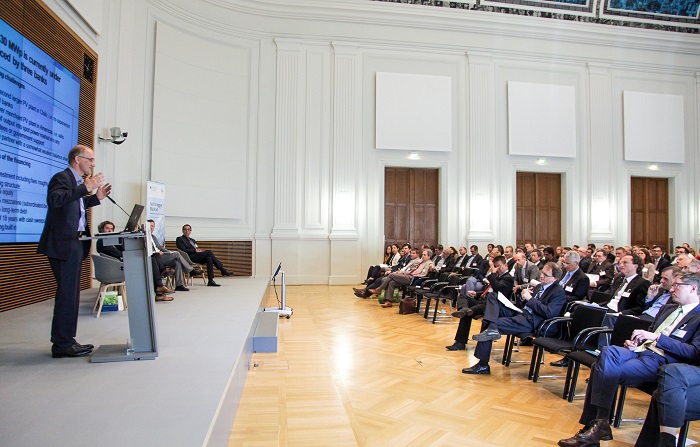
An innovative solution for dealing with strong performance peaks ‒ with electricity fed in from PV plants and wind farms ‒ was presented at the University of Darmstadt on 16th March. The research project Flex4Energy showed how bottlenecks in the distribution network can be avoided with an energy storage tank and a marketplace where electricity potential can be traded.
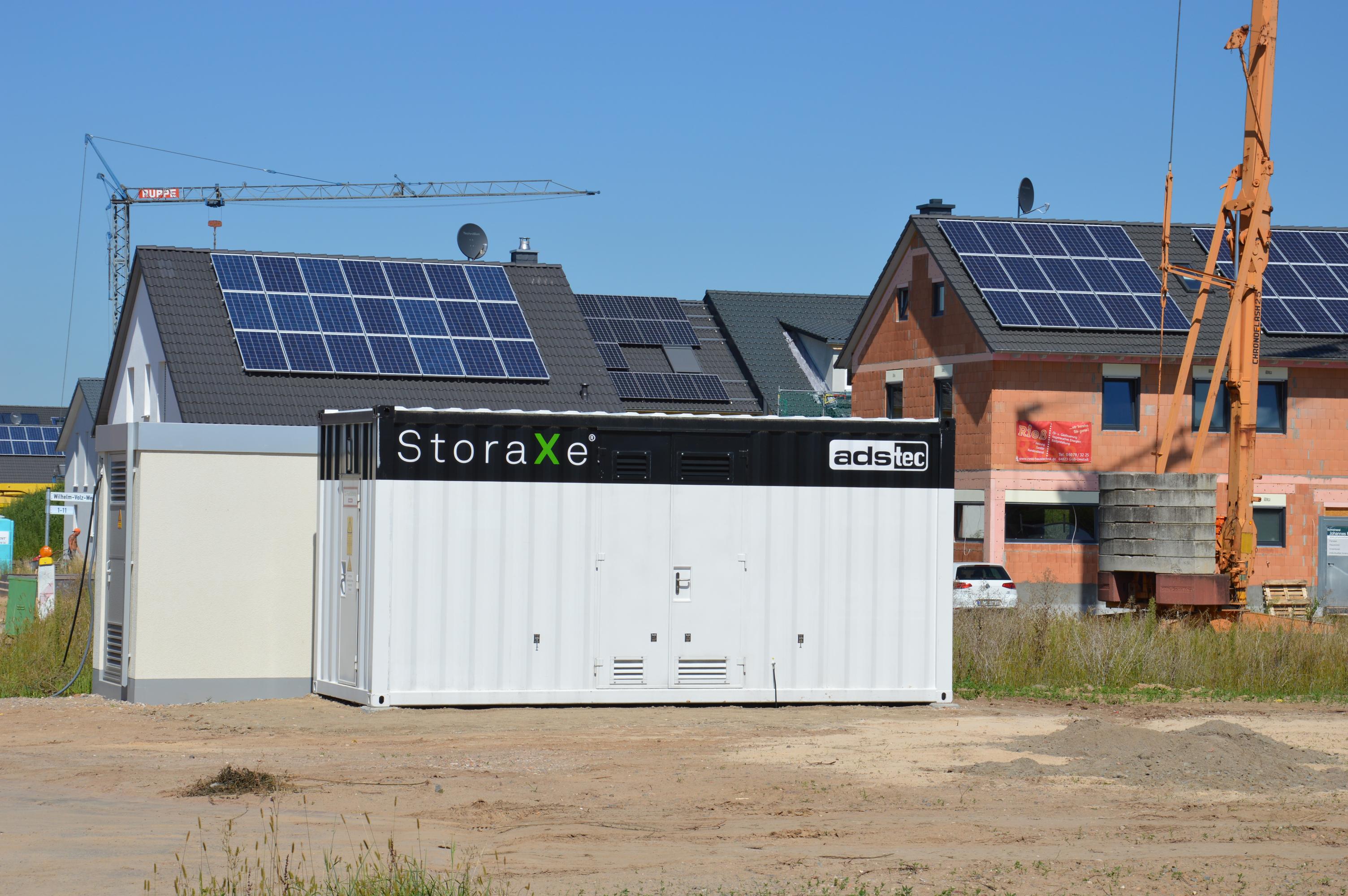
In a new development area in the town of Groß-Umstadt, near Frankfurt am Main, a district energy tank stored the performance peaks from nearby rooftop PV systems. In addition, a lithium-ion battery storage system, with 100kw performance and 100 kWh capacity, offered surplus electricity potential on a virtual marketplace. This could then be requested by regional grid operators in times of unexpected supply bottlenecks and allocated using a trading algorithm.
One of the conclusions drawn by the project partners of the University of Darmstadt, ENTEGA AG, Fraunhofer ISE, Fraunhofer IESE and the Ads-Tec GmbH – project management: StoREgio GmbH – was that the additional use slowed down the ageing process of the storage systems to a far greater extent than expected. For grid operators, a functioning regional system for trading with flexibilities could increase the security and quality of energy supply and potentially minimize investments in grid expansion.
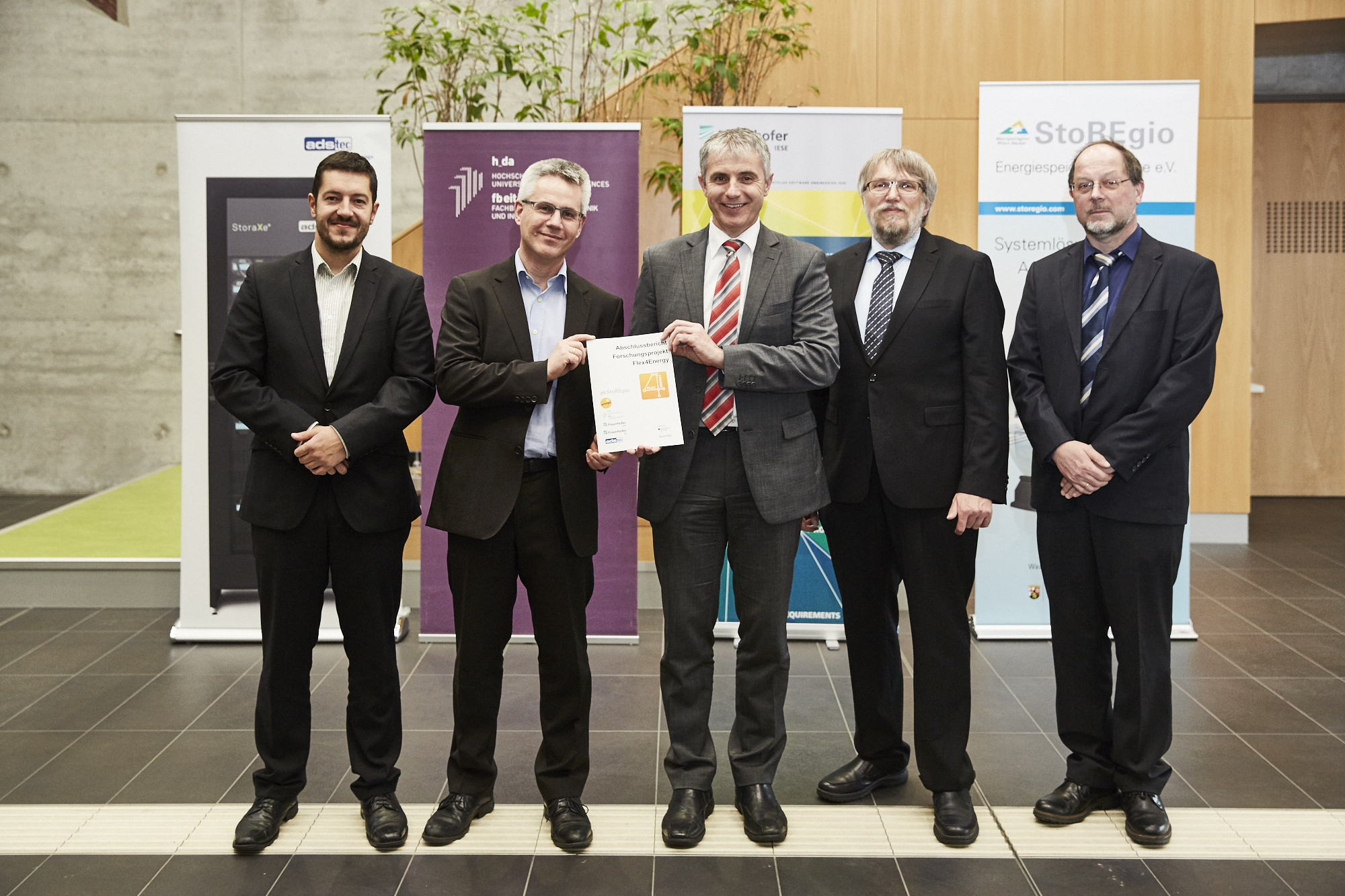
The project partners of Flex4Energy, from left to right: Denis Uecker (Fraunhofer IESE), Dr. Peter Eckerle (StoREgio), Bernhard Fenn (ENTEGA), Prof. Dr. Klaus-Martin Graf (Hochschule Darmstadt), Prof. Dr. Johannes Gerdes (Hochschule Darmstadt).


![Logo [EN]German Energy Solutions](/SiteGlobals/GES/StyleBundles/Bilder/sublogo_en.svg?__blob=normal&v=1 "To homepage")